
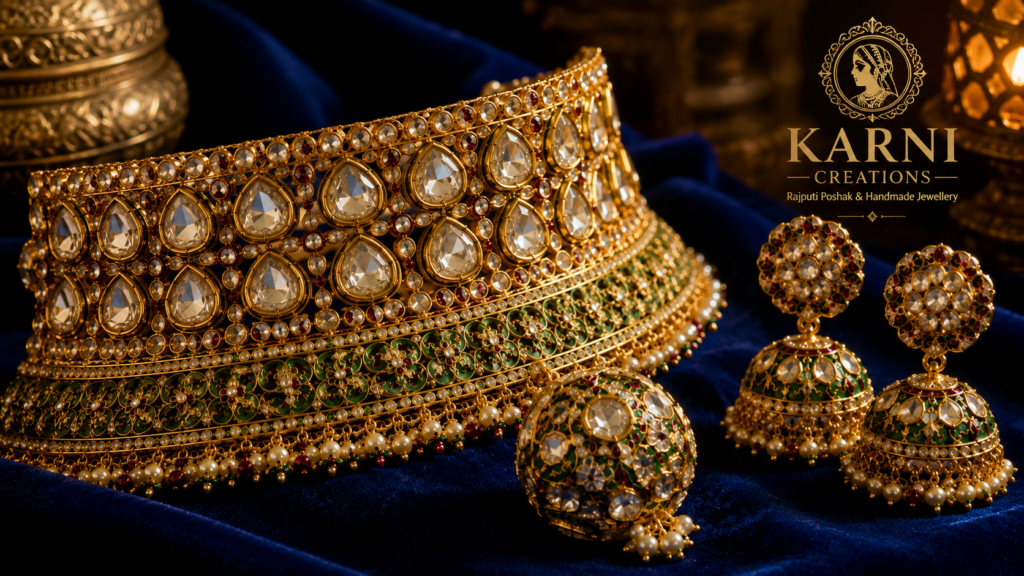
Pachi Kundan jewellery is handmade Indian jewellery where uncut stones are set into soft, pure gold foil entirely by hand, with no machines and no casting. It came from the royal workshops of Rajasthan and Gujarat, and it is a favourite for brides because of its raw, regal shine.
This guide explains what Pachi Kundan really is, how it is made, how it differs from regular Kundan and Polki, the main types, and how to tell a real piece from a fake before you buy.
Key takeaways
- Pachi Kundan sets uncut stones into hand-pressed pure gold foil, with no machine casting.
- It began in the royal courts of Rajasthan and Gujarat and spread under the Mughals.
- It is softer and more handmade than regular Kundan; Polki is the diamond-based, costlier cousin.
- Real pieces show meenakari enamel on the back, slightly uneven stone edges, and real weight.
- It suits bridal and festive wear, not daily use, because the lac base and foil are delicate.
What Is Pachi Kundan Jewellery?
The name says it. “Pachi” means raw or uncut stones, and “Kundan” is the old technique of setting those stones into purified gold foil. Put together, Pachi Kundan is uncut stones held in place by hand-pressed gold foil. It is one of the slowest, most hands-on jewellery techniques in India.
A real Pachi Kundan piece uses a few things: uncut or raw stones (sometimes coloured glass for brightness), thin sheets of pure gold foil, a base of natural lac (resin), and very often meenakari (enamel) work painted on the back.
The craft goes back to the royal courts of Rajasthan and Gujarat and grew under Mughal patronage, when setting uncut gems in gold became a mark of nobility. The same designs sit at the centre of Rajputi and Rajasthani bridal jewellery today, and families pass them down for generations.
How Pachi Kundan Jewellery Is Made
What makes Pachi Kundan special is the slow, all-manual process behind every piece. It moves through several skilled hands:
- The frame. A base is shaped from gold or silver to hold the design.
- The lac base. Natural lac (resin) is melted and filled into the frame to seat the stones.
- Setting the stones. Uncut stones are placed into the lac one by one.
- The kundan step. Thin layers of pure gold foil are pressed by hand around each stone to lock it in. This hand-pressing is the heart of Pachi work.
- Meenakari. Coloured enamel is painted onto the back for the finish.
Because every step is done by hand, a real Pachi Kundan piece has a softer, slightly flexible build and small, natural irregularities. That handmade character is what buyers look for.
Pachi Kundan vs Regular Kundan vs Polki
These three get mixed up because they look similar and share the same gold-foil family. Here is the difference:
| Feature | Pachi Kundan | Regular Kundan | Polki |
|---|---|---|---|
| Stones | Uncut / raw stones, often with coloured glass | Glass stones set in refined gold | Uncut natural diamonds |
| Setting | Hand-pressed gold foil; softer and flexible | Firmer, more rigid framework | Gold-foil (jadau) setting |
| Finish | Handmade, slight irregularities | More uniform and fixed | Raw, old-world sparkle |
| Look | Soft, organic, regal | Polished and structured | Brilliant, diamond-led |
| Price | Higher (intensive handwork) | Generally lower | Highest (real diamonds) |
Pachi Kundan is the softer, fully handmade form of Kundan with uncut stones. Polki is the diamond-based cousin and usually the priciest of the three.
Types of Pachi Kundan Jewellery
Pachi Kundan work shows up across almost every traditional ornament, especially in a full Rajputi bridal set:
- Aad / Choker — a broad, close-fitting neck piece, one of the most recognised Rajasthani ornaments.
- Timaniya — a small, dainty choker, usually a three-string design worn high on the neck.
- Rani Haar / Maharani Haar — a long necklace reaching the waist for a layered look.
- Borla / Rakhdi — the round maang tikka of Rajasthan, worn on the forehead.
- Sheeshphool & Matha Patti — hair pieces that frame the parting and hairline.
- Nath — the nose ring, often joined to the ear with a fine chain.
- Jhumka & Earrings — bell-shaped drops that complete the bridal frame.
- Bajuband — the upper-arm armlet, a Rajputi staple.
- Kamarband — a waist belt worn over the lehenga or poshak.
- Bangles & Rings — the finishing pieces of a set.
- Complete bridal sets — matched pieces made to go with a Rajputi poshak.
How to Spot a Real Pachi Kundan (7 Checks)
This is where buyers get fooled. Run these seven checks before you pay:
- Turn it over. Real Pachi Kundan almost always has meenakari (enamel) on the back. Mass-made fakes leave the back plain, glued or stamped.
- Look for handmade unevenness. Slight asymmetry in the stones is a good sign; it means real handwork. Perfectly identical, machine-precise stones point to a factory piece.
- Check the foil setting. Real kundan uses thin pure gold foil pressed around each stone. Cheap pieces use glued or clamped settings you can sometimes see at the edges.
- Feel the flex. Pachi has a softer, slightly flexible build, not the stiff feel of cast metal.
- Study the stones. Real pieces use a raw, uncut look. Be careful with over-bright, perfectly faceted sparkle, which is usually glass or CZ posing as diamond.
- Ask for the hallmark. For gold, ask for a BIS hallmark and purity; real gold-foil work has genuine weight. For silver, look for the 925 stamp.
- Buy from a known maker, and get it in writing. Ask for a purity or authenticity certificate with a clear breakdown of metal and stone. A price that looks too low for real Pachi Kundan usually means glass with plating.
How to Care for Pachi Kundan Jewellery
Pachi Kundan is delicate because of its lac base and gold foil, so it needs gentle care:
- Store each piece on its own, in a soft cloth or lined box.
- Keep it away from water, perfume and sweat. Moisture can loosen the lac and foil.
- Put it on last when you are getting ready, and take it off first.
- Wipe it with a dry, soft cloth only. Skip liquid cleaners and ultrasonic machines.
- For re-polishing, take it back to your jeweller instead of trying a home fix.
Why Pachi Kundan Works for Brides and Festive Wear
Few styles carry the royal look the way Pachi Kundan does. It goes with a Rajputi poshak or lehenga, holds real heirloom value, and suits weddings, Teej, Gangaur and festive functions. For a bride who wants the full Rajasthani look, the borla on the forehead, the aad at the neck, the bajuband on the arm, Pachi Kundan is the centre of it.
Frequently Asked Questions
What does “Pachi” mean in Pachi Kundan?
“Pachi” means raw or uncut stones, and “Kundan” is the technique of setting those stones into pure gold foil. Together they describe uncut stones held by hand-pressed gold foil.
Where does Pachi Kundan jewellery come from?
It comes from the royal courts of Rajasthan and Gujarat and grew under Mughal rule, when setting uncut gems in gold was a mark of nobility.
Is Pachi Kundan jewellery made of real gold?
It can be. Real Pachi Kundan uses gold foil, and sometimes a gold or silver base. Ask for the hallmark and a purity certificate. Many affordable pieces use silver or gold-plated bases with the same handmade technique.
What stones are used in Pachi Kundan?
Uncut stones, often diamonds, emeralds, rubies or sapphires, and sometimes coloured glass for brightness. The back usually carries coloured meenakari enamel.
Pachi Kundan vs Kundan, which one is better?
Neither is strictly better. Pachi is a softer, more handmade form of Kundan with uncut stones and meenakari on the back. If you want a richer, more artisanal feel, Pachi Kundan stands out.
What is the difference between Pachi Kundan and Polki?
Polki uses uncut natural diamonds, which makes it the most expensive. Pachi Kundan uses uncut stones and coloured glass set in hand-pressed gold foil, with a softer, handmade finish.
Is Pachi Kundan the same as Jadau?
They are related. Jadau is the broad technique of embedding stones into gold with foil and no soldering. Pachi Kundan is a hand-pressed form of that craft using uncut stones.
How do I know if my Pachi Kundan is real (asli kaise pehchane)?
Check the back for meenakari, look for slight handmade unevenness, confirm the gold-foil setting, and ask for a hallmark and authenticity certificate. A price that looks too cheap is the biggest warning sign.
Is Pachi Kundan jewellery expensive?
It costs more than ordinary imitation jewellery because every piece is handmade and uses gold foil. The exact price depends on the metal base, the stones and the size.
Is Pachi Kundan jewellery good for brides?
Yes. It pairs with a Rajputi poshak or lehenga and suits weddings, Teej, Gangaur and other festive functions. Many brides treat it as an heirloom piece.
Can Pachi Kundan be worn every day?
It is best kept for weddings and special occasions. The lac base and gold foil are delicate and can be damaged by daily wear, water and sweat.
How should I store Pachi Kundan jewellery?
Keep each piece on its own in a soft cloth or lined box, away from water and perfume, and clean it only with a dry soft cloth.
Does Pachi Kundan jewellery tarnish?
With proper storage and care it keeps its shine for years. Keep it dry, store it separately, and clean it with a soft dry cloth.
Can Pachi Kundan jewellery be repaired?
Yes, a skilled kundan jeweller can reset loose stones and re-polish a piece. Avoid home repairs, since the lac and foil are easy to damage.