
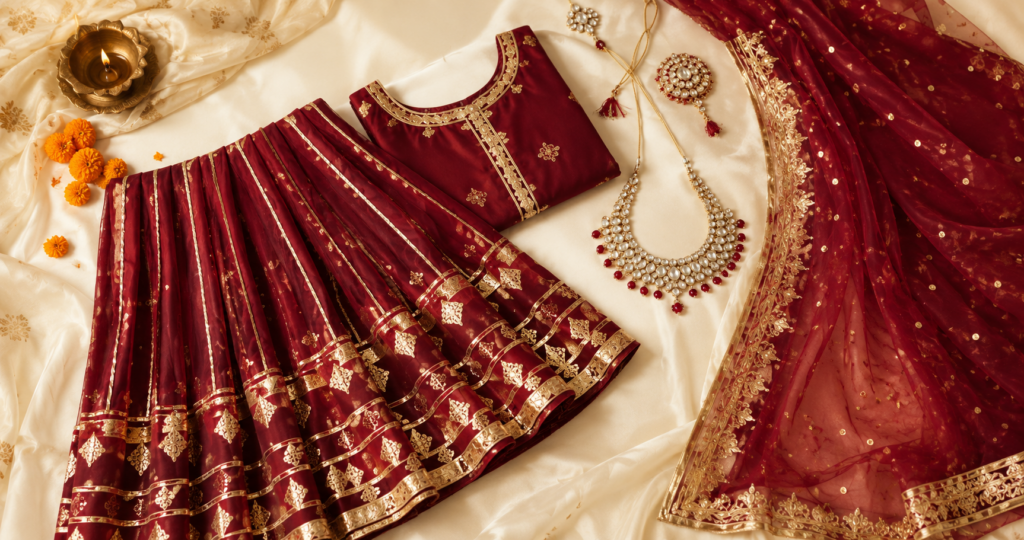
A Rajputi Poshak is the traditional dress worn by Rajput women in Rajasthan. It is made of four pieces — the kurti, kanchli, ghaghra and odhna — and is worn at weddings, Teej and Gangaur. Today it ranges from light cotton for everyday wear to real-silver gota work that families keep as an heirloom.
If you have grown up in Rajasthan, the poshak needs no introduction. For everyone else, it is the long, four-piece dress you see Rajput women wearing at weddings and festivals — full skirt, fitted top, and a veil that falls to the floor. It is not a single garment but a coordinated set, and the way it is cut, dyed and worked tells you the occasion it was made for. This guide covers where the poshak comes from, what it is made of, the main types you can buy, what they cost, how it differs from a lehenga or saree, and how to choose and care for one.
Where does the Rajputi Poshak come from?
The poshak belongs to the royal courts of Rajasthan, where the women of Rajput households wore it as everyday and ceremonial dress. The cut was practical for its time — a long ghaghra and a full odhna covered the body, and the veil could be drawn forward as a ghunghat. What began as court dress slowly became the formal wear of Rajput families across Marwar, Mewar and Shekhawati, each region adding its own colours and styling.
The handwork has roots in the same courts. Skilled tailors once used real gold and silver thread to decorate poshak for royal families, which is where the tradition of real-silver gota comes from. That heritage is still alive in a pure poshak today, even as cotton and synthetic-gota versions have made the style affordable for everyday wear.
What are the four parts of a Rajputi Poshak?
A poshak is a set of four pieces worn together. On a simple cotton poshak the work is light; on a bridal poshak all four pieces carry matched handwork so the outfit reads as one.
- Kurti — the upper garment, usually short, worn over the kanchli. It carries much of the visible handwork on the bodice and sleeves.
- Kanchli — a fitted inner blouse worn under the kurti. Together they are often called the “kurti-kanchli”, and a good fit here decides how the whole poshak sits.
- Ghaghra — the long, heavily pleated skirt. A well-made ghaghra has plenty of flare and fabric, which is what gives the poshak its sweep when you walk or sit.
- Odhna — the veil, also called lugdi or chunari. It is long, usually 2.5 to 3 metres, and is draped over the head and shoulder. On a jod odhna set, the odhna is dyed and worked to match the rest of the poshak exactly.
What are the different types of Rajputi Poshak?
People shop for poshak in three ways: by fabric, by the kind of handwork, and by the occasion or region it belongs to. Most pieces combine all three — for example, a satin bridal poshak with gota patti work.
By fabric
A cotton poshak in mulmul is the lightest and best for daily wear and Rajasthan summers. A satan (satin) poshak adds a festive sheen and drapes well at a mid-range price. Georgette and chiffon are chosen when you want movement and a softer fall. For grand occasions, a Banarasi suit uses woven silk and zari, while pure tissue and silk poshak sit at the top of the range.
By handwork
The handwork usually decides the price. Gota patti is the classic Rajasthani ribbon work, stitched flat onto the fabric in patterns and borders. Zardozi is raised metallic embroidery and feels heavier, which suits big functions and bridal wear. Mirror, sequin and mokesh work are added for sparkle. The most prized of all is the pure (real silver) poshak, where the gota is real silver rather than imitation thread.
By occasion and region
A bridal poshak carries the heaviest work and is made for the wedding day, usually in red, maroon or rani pink. A lehariya poshak, with its diagonal wave tie-dye, is traditional for Teej and the monsoon. A faganiya poshak in bright tones belongs to Phagun and Holi. By region, the Marwadi poshak follows Jodhpur styling, the baisa poshak is the daughter-of-the-house style, and a humrai poshak is the coordinated poshak worn by the bride’s family and companions so the group looks matched.
Rajputi Poshak vs lehenga and saree: what is the difference?
A poshak is often confused with a lehenga because both have a long skirt. The difference is in the pieces and the drape. A lehenga is a three-piece outfit — blouse, skirt and a shorter dupatta — and is worn across India. A poshak is a four-piece set specific to Rajput women, with a kurti over a kanchli and a long odhna draped over the head. A saree is a single length of cloth draped over a blouse. Here is the quick comparison.
| Rajputi Poshak | Lehenga | Saree | |
| Pieces | Four (kurti, kanchli, ghaghra, odhna) | Three (blouse, skirt, dupatta) | One draped cloth + blouse |
| Origin | Rajput women of Rajasthan | Pan-Indian festive wear | Pan-Indian, all regions |
| Top | Kurti over a fitted kanchli | Fitted choli/blouse | Separate blouse |
| Veil/drape | Long odhna over head and shoulder | Shorter dupatta | The saree itself is the drape |
Pure poshak vs regular poshak: what is the difference?
This is the question we are asked most often. The short version: a pure poshak uses real silver, a regular poshak uses imitation gota. Here is the full comparison.
| Pure (real silver) poshak | Regular poshak | |
| Gota material | Real silver gota and zari | Metallic imitation gota |
| Weight & shine | Heavier, with a deeper shine that lasts | Lighter; the shine can dull over time |
| Price | Highest, in the heirloom range | Entry to mid range |
| Best for | Brides and family heirlooms | Festivals, daily and occasional wear |
| Lifespan | Passes down across generations with care | Suited to regular, everyday use |
If you want one poshak that will be worn at your wedding and then kept for the next generation, the pure poshak earns its price. For festivals and regular wear, a well-made regular poshak in gota patti gives you the same look for far less.
How much does a Rajputi Poshak cost?
Price depends on three things: the fabric, the amount of handwork, and whether the gota is real silver. As a rough guide for handcrafted poshak:
- Cotton and everyday poshak — from around ₹5,000.
- Festive and bridal poshak — roughly ₹12,000 to ₹35,000, depending on the work.
- Pure (real silver) poshak — higher again, set by the silver content and the hours of handwork.
Two pieces with the same fabric can sit far apart in price simply because one has dense gota patti and the other has a light border. Custom stitching to your measurements may add a little to the cost, but it is what makes a poshak fit properly. When you compare quotes, look at how much of the poshak is actually worked, not just the headline rate.
When is a Rajputi Poshak worn?
It is the dress of celebration. Brides and their families wear it for the wedding and its ceremonies — the mahila sangeet, the pheras, the reception. Beyond weddings, the lehariya poshak comes out for Teej, bright poshak for Gangaur and Karwa Chauth, and faganiya colours for Holi. Many women in Rajasthan also keep a simple cotton poshak for everyday wear at home, and NRIs often buy one to wear at family weddings and cultural events abroad.
How is the odhna draped?
The odhna is what turns the outfit into a poshak. One end is tucked into the ghaghra at the waist; the length is then brought up across the body, over the shoulder, and drawn over the head. For a bride, the front of the odhna is often pulled forward as a light ghunghat. Because the odhna is long, it helps to have a second pair of hands the first time you wear it, and a few well-placed pins keep it in place through a long event. A jod odhna, worked to match the poshak, sits best because the weight is balanced across the set.
Buying a Rajputi Poshak online: what to check
Buying a poshak online is normal now, including from outside India, but a few checks save disappointment on a piece this important.
- Measurements and stitching — confirm whether the poshak comes stitched to your size or unstitched, and what measurements the maker needs.
- Real vs imitation silver — if you are paying for a pure poshak, ask the seller to confirm the gota is real silver, not metallic imitation.
- Fabric and work — check the fabric, the type of handwork, and how much of the poshak is worked, since this drives both the look and the price.
- Shipping and customs — for orders abroad, check the delivery time and whether customs duty is handled, so there is no surprise at delivery.
- Lead time — custom-stitched poshak take a few extra days, so order well ahead of your wedding or festival date.
At Karni Creations every poshak is cut, dyed and gota-worked by hand in Jaipur, then stitched to your measurements before it ships. You can complete the look with matching pachi kundan jewellery — a rakhdi or borla on the forehead, an aad or timaniya at the neck — and a set of bridal bangles.
How do you care for a Rajputi Poshak?
Heavy gota and zardozi work do not take well to washing machines. Store the poshak folded flat, with the odhna kept separately so the work does not crush. Keep perfume and hairspray away from the gota, since they can tarnish it. A pure silver poshak lasts longest wrapped in soft muslin between wears, and any heavy piece is best left to a trusted dry cleaner. Treated this way, a good poshak stays wedding-ready for years.
Every Karni Creations poshak is cut, dyed and gota-worked by hand in Jaipur, then stitched to your size and shipped worldwide. Explore the Rajputi Poshak collection.
Rajputi Poshak — Frequently Asked Questions
Everything brides and shoppers ask us about the Rajputi Poshak — what it is, the types, prices, sizing and care.
About the Poshak
What is a Rajputi Poshak?
A Rajputi Poshak is the traditional dress of Rajput women in Rajasthan. It has four pieces — kurti, kanchli, ghaghra and odhna — and is worn at weddings, Teej, Gangaur and other festivals.
What does the word “poshak” mean?
“Poshak” simply means attire or dress in Hindi. The Rajputi Poshak is the specific four-piece traditional dress of Rajput women, different from a lehenga or a saree.
What are the four parts of a Rajputi Poshak?
The four pieces are the kurti (top), the kanchli (a fitted inner blouse), the ghaghra (a long pleated skirt) and the odhna (a long veil, usually 2.5 to 3 metres). On a bridal poshak all four carry matched handwork.
What is an odhna or lugdi?
The odhna, also called lugdi or chunari, is the long veil of the poshak. It is draped over the head and shoulder, and on a jod odhna set it is dyed and worked to match the poshak.
Types & Handwork
What fabrics are Rajputi Poshak made of?
Common fabrics are cotton (mulmul) for daily wear, satin and georgette for festive wear, and Banarasi silk, pure tissue and silk for grand occasions. Lighter fabrics suit summers; richer ones suit weddings.
What is gota patti work?
Gota patti is Rajasthan’s classic ribbon work, where flat gold- or silver-look gota is stitched onto the fabric in borders and motifs. It is the handwork most associated with the Rajputi Poshak.
What is a lehariya poshak?
A lehariya poshak uses Rajasthan’s wave tie-dye, recognised by its diagonal striped pattern. It is traditionally worn for Teej and the monsoon season.
What is the difference between a Rajputi Poshak and a lehenga?
A lehenga is a three-piece outfit — blouse, skirt and dupatta — worn across India. A Rajputi Poshak is a four-piece set specific to Rajput women, with a kurti over a kanchli and a long odhna draped over the head.
What is the difference between a poshak and a Rajputi suit?
A poshak is the four-piece ghaghra set worn for weddings and festivals. A Rajputi suit is a stitched kurti with salwar or pants in Rajputi prints and work, which is easier for daily and casual wear.
What is the difference between a pure poshak and a regular poshak?
A pure (or “pyor”) poshak uses real silver gota and zari. It is heavier, holds its shine, and is kept as a family heirloom. A regular poshak uses metallic imitation gota at a lower price, ideal for festivals and everyday wear.
Price & Buying
How much does a Rajputi Poshak cost?
Handcrafted cotton and everyday poshak start around ₹5,000. Festive and bridal pieces usually run from ₹12,000 to ₹35,000, and real-silver pure poshak go higher depending on the silver and the handwork.
Where can I buy an authentic Rajputi Poshak online?
Buy from a Jaipur maker who handcrafts the poshak, such as Karni Creations. Check that it is stitched to your size, and for a pure poshak confirm the gota is real silver, not imitation.
What jewellery is worn with a Rajputi Poshak?
The poshak is paired with pachi kundan jewellery — a rakhdi or borla on the forehead and an aad or timaniya at the neck — along with a set of bridal bangles for the complete look.
Do you ship Rajputi Poshak outside India?
Yes. Karni Creations ships from Jaipur to the USA, UK, Canada, UAE, Australia and beyond, with tracking and customs handled. Delivery time and charges vary by country.
Sizing & Care
Can a Rajputi Poshak be stitched to my size?
Yes. Share your measurements and the kurti, ghaghra and odhna are tailored to fit. Custom stitching usually adds a few days before dispatch, so it helps to order ahead of your date.
How do you drape the odhna?
One end is tucked into the ghaghra at the waist, then the length is brought across the body, over the shoulder, and drawn over the head. For a bride, the front is often pulled forward as a light ghunghat, and a few pins hold it through a long event.
How do you care for a Rajputi Poshak?
Store it folded flat with the odhna kept separately so the work does not crush, and keep perfume and hairspray away from the gota. Wrap a pure silver poshak in soft muslin between wears, and dry clean heavy gota or zardozi pieces.